3 min read

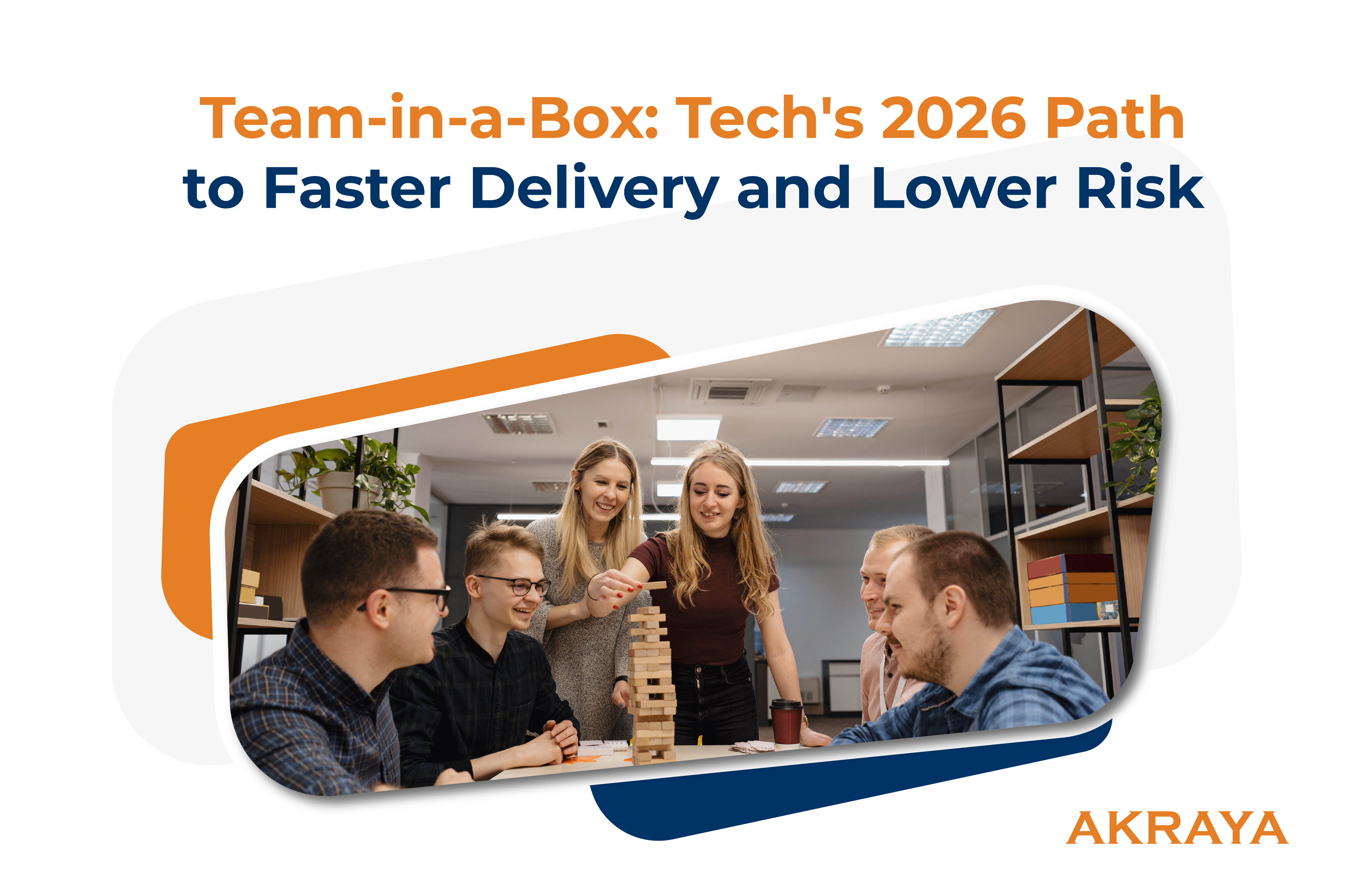
Team-in-a-Box: Tech's 2026 Path to Faster Delivery and Lower Risk

Team-in-a-Box: Tech's 2026 Path to Faster Delivery and Lower Risk


Team-in-a-Box: Tech's 2026 Path to Faster Delivery and Lower Risk

Team-in-a-box models are poised for strong growth in 2026 and beyond because they solve several pain points that traditional staffing and single-role hiring cannot address, especially for tech organizations that need speed, flexibility, and accountability. Since direct access to current industry reports is not available in this environment, the points below draw on established patterns in how project-based and outcomes-focused staffing have evolved over the last decade.​


 The rise of outcome-focused teams

Tech roadmaps are more complex and work increasingly happens through cross-functional squads instead of isolated roles. A team-in-a-box model packages the full blend of skills required to deliver a defined outcome, rather than expecting clients to assemble those capabilities one hire at a time. This structure aligns naturally with how modern product, engineering, and data teams operate in agile environments.​

According to recent project management and Agile research, organizations that adopt Agile practices report Agile projects being successful about 64 percent of the time and achieving productivity improvements of up to 47 percent, which reinforces the impact of well structured, cross functional teams on delivery outcomes.


What tech leaders gain immediately

A well-designed team-in-a-box model offers several concrete advantages for tech organizations:​

  • Faster time to impact: Clients get a pre-aligned, ready-to-work team instead of waiting through multiple individual hiring and onboarding cycles.
  • Built-in collaboration: The team already has working norms, division of responsibilities, and communication practices, which reduces friction and accelerates delivery.
  • Clear scope and ownership: Work is framed around deliverables and outcomes, making it easier to measure value and manage expectations.
  • Reduced management overhead: Leaders spend less time coordinating multiple vendors or contractors and more time focusing on priorities and strategy.
  • From an ROI perspective, the value shows up as shorter ramp-up time, fewer mis-hires, and more predictable delivery against roadmap commitments.​


Superior returns, lower risk

Compared with traditional role-based staffing, team-in-a-box models tend to deliver better ROI in several ways:​

  • Lower risk of skill gaps: The team is curated to include the right balance of senior and junior talent, plus specialized skills that would be expensive or slow to hire individually.
  • More predictable spend: Pricing is typically structured around a team unit and time frame, which makes budgeting easier than managing a long list of individual rates.
  • Higher throughput per dollar: Because the team is optimized as a unit, you avoid the productivity loss that occurs when individually sourced contributors struggle to integrate.
  • For tech organizations under pressure to deliver features, improve reliability, or launch new initiatives without expanding permanent headcount, this combination of speed, cohesion, and predictability is particularly attractive.​

Studies on outsourcing and managed models show that the global outsourcing services market is on track to reach roughly 867 billion dollars by 2027, as more companies rely on external teams to improve efficiency, control costs, and reduce operational risk.


Why execution sets us apart

Although many providers can supply individual contractors, relatively few can consistently deliver high-performing, plug-in teams. That is where Akraya's differentiation lies. Building a credible team-in-a-box offering requires a strong talent network, proven lead engineers or architects, and established playbooks for how teams are staffed and rotated.

Mature providers also bring repeatable delivery frameworks, including templates for discovery, sprint planning, communication cadence, and reporting that make each engagement more consistent and lower risk for clients.

Teams with domain and tech specialization, such as expertise in specific stacks, industries, or problem spaces like SaaS platforms, data products, or internal tools, ramp faster and make better decisions. Positioning this clearly makes it obvious that team-in-a-box is not just a label for any group of contractors, but a structured offering backed by process, leadership, and quality control.


Roadmap protection without the hassle

One of the biggest advantages for tech leaders is the reduction of backfill risk and dependency on specific individuals:​

  • Continuity by design: In a team-in-a-box model, the provider owns continuity. If a team member rolls off, the provider is responsible for backfilling and knowledge transfer, not the client.
  • Less disruption to roadmaps: Because the team is managed as a unit, churn in one role does not stall an entire initiative. The provider’s internal processes absorb most of that shock.
  • Focus on outcomes, not seats: Tech leaders can concentrate on roadmap priorities, KPIs, and stakeholder alignment, instead of constantly worrying about vacancies, rehiring cycles, and onboarding.
  • For engineering, product, and data leaders, this means more predictable delivery and fewer “fire drills” when someone leaves mid-project. Over time, that translates into stronger stakeholder trust and better use of leadership time.​

Ready to Accelerate Your 2026 Roadmap?

Akraya's Team-in-a-Box delivers pre-aligned, high-performing teams built for your specific tech stack and outcomes. No hiring delays. No backfill worries. Just faster delivery and measurable impact.
Contact us today to build your next team and stay ahead of the curve. [Learn more about Team-in-a-Box]

How can we help you today?

Case Studies

Accelerating Application Modernization for a Global Commerce Leader

Akraya transformed application infrastructure into a $900M+ revenue accelerator, enabling scalable growth and future-proofing against next-gen demands.

Case Study - Walmart Sams Club PM Staffing
Unlocking Revenue Growth for a Fortune Retailer with Talent On Demand

Akraya’s talent-on-demand strategy transformed merchandising into a predictive revenue engine, driving $8.4B in new sales and enabling the most responsive omnichannel system in the industry.