AI Powered Digital Twins: The Self-Correcting Supply Chains Cutting Recovery Time by 28 Percent
3 min read
Rinki Yumnam : December 11, 2025
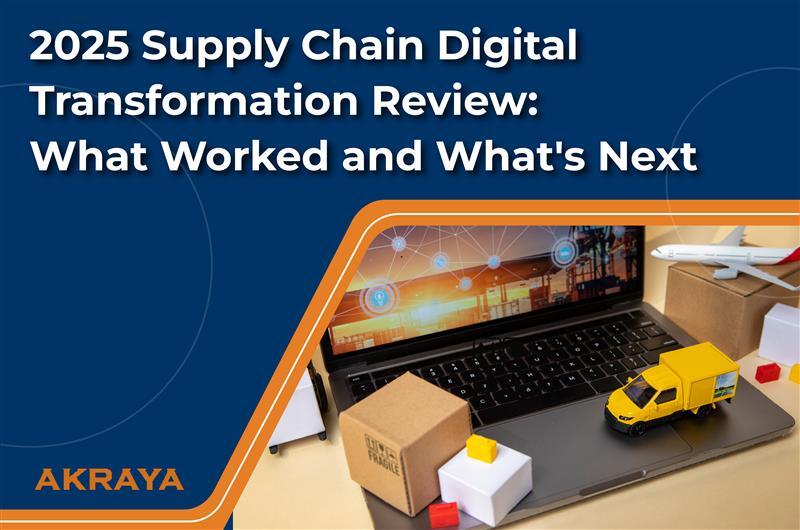
2025 proved to be a turning point for many companies’ supply chain strategies. After a series of disruptions, global supply chain stresses, and shifting consumer demands, organizations began to realize that piecemeal fixes would not be enough. Digital transformation moved from being a nice to have to essential infrastructure.
Companies that succeeded in 2025 treated supply chain transformation not as an IT project, but as a core business capability that touches procurement, logistics, inventory, operations, and strategic planning. As we step into 2026, the lessons learned are valuable and the roadmap ahead is clearer.
One of the biggest gains came from replacing legacy, siloed systems with cloud-based supply chain platforms. This shift helped break down data silos between procurement, logistics, manufacturing, and distribution, enabling real-time coordination and improved visibility. Organizations that adopted these systems saw better alignment across teams and greater agility when demand or supply disruptions occurred.
Automation and robotics also made a significant impact, especially in warehousing and distribution centres. Automated inventory tracking, robotic picking and packing, and smart logistics reduced manual errors, increased throughput, and helped manage labor volatility in tight markets.
Adoption of predictive analytics and demand forecasting tools grew as well. Companies began using data from past sales, supply delays, market trends, and external signals such as raw material costs or shipping lead times to forecast demand, plan procurement, and buffer inventory more intelligently. This proactive approach helped reduce both stockout risk and excess inventory.
Beyond tools, 2025 saw more companies invest in integration and stakeholder alignment. Rather than rolling out technology in silos, forward-looking organizations aligned IT, operations, supply chain, and leadership stakeholders. This increased adoption, improved data hygiene, and maximized return on investment. Integration made transformation real rather than superficial.
Even with good intentions, many digital transformation efforts in 2025 faced execution problems. A frequent challenge was changing management. Teams often underestimated the organizational disruption that comes with new systems. Legacy staff had ingrained habits, and old processes were deeply rooted. Without proper change communication and training, adoption lagged.
In several cases, companies deployed analytics or automation before their data infrastructure was ready. Poor data quality, fragmented sources, and inconsistent data governance meant that AI or forecasting models delivered unreliable outputs. This quickly undermined confidence in the systems.
Some firms tried to do too much at once, replacing multiple systems, automating operations, and overhauling processes in a single wave. That often led to partial rollouts, delays, and diluted returns. The result was transformation that looked promising on paper but failed to deliver real impact.
Finally, a few companies treated digital transformation as a onetime project rather than a continuous capability. Once initial upgrades were done, further investment, training, and iteration stalled. In a dynamic environment, this meant early gains quickly lost value.
In 2026, the transformation story shifts from adoption to orchestration:
Sustainability and risk resilience will also become core priorities:
Another major shift will be empowering non-IT teams with low code or modular tools:
Finally, talent strategy will matter more than ever:
Why 2026 Will Reward Vision, Not Just Tools
Digital transformation is not about acquiring technology. It is about building capability. Companies that treat the supply chain as a dynamic system, where tools, people, data, and processes continuously evolve, will thrive. In 2026, the winners will be those who adapt quickly, align broadly, and commit to iterative improvement rather than one time fixes.
At Akraya, we partner with enterprises to accelerate supply chain digital transformation. Whether it is staffing specialized analytics teams, deploying managed automation experts, or consulting on strategy and execution, our flexible and scalable talent solutions help you move faster and reduce execution risk. If you are planning for 2026 transformation or scaling automation and analytics initiatives, let us help you build a future ready supply chain. Reach out to us today.
Akraya transformed application infrastructure into a $900M+ revenue accelerator, enabling scalable growth and future-proofing against next-gen demands.
Akraya’s talent-on-demand strategy transformed merchandising into a predictive revenue engine, driving $8.4B in new sales and enabling the most responsive omnichannel system in the industry.
AI Powered Digital Twins: The Self-Correcting Supply Chains Cutting Recovery Time by 28 Percent
Why UX Research Is the Secret Weapon of Successful Product Teams
How to Scale User and Market Research Without Hiring: RaaS for 2025 Product Teams Why Research Gets Squeezed in Lean Product Environments