3 min read

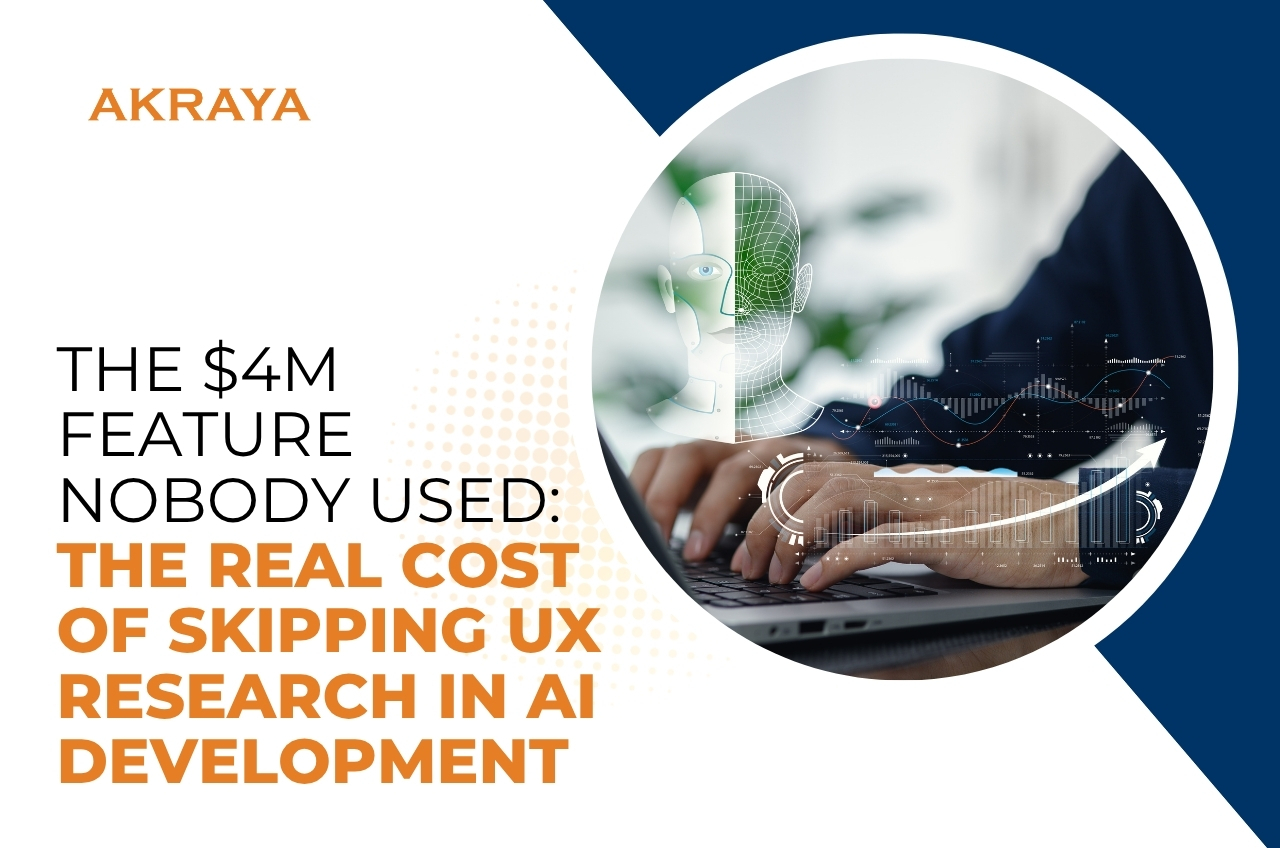
The $4M Feature Nobody Used: The Real Cost of Skipping UX Research in AI Development

The $4M Feature Nobody Used: The Real Cost of Skipping UX Research in AI Development

The $4M Feature Nobody Used: The Real Cost of Skipping UX Research in AI Development

Product teams skip UX research for the best reasons. The timeline is tight. The board wants to see AI features on the roadmap. The model is performing well in benchmarks. What's left to validate?

Quite a lot, as it turns out.

Akraya's UXR practice has identified three patterns that emerge consistently in organizations that skip human validation on AI products. We call them Ghost Tools, the Trust Gap, and the Sunk Cost Trap. All three are expensive. All three are preventable.


Pattern 1: Ghost Tools, The Invisible Product

Ghost Tools are AI features that are technically functional but effectively invisible. They automate tasks users don't find difficult, or they're too fragile for the complex tasks users actually need help with. The result is a high-cost engineering effort with near-zero adoption and a 0% return on development spend.

Ghost Tools emerge when organizations move straight from technical benchmarks to market launch, bypassing the discovery research that would have identified whether there is a genuine 'Value Floor, ’ a minimum level of utility that makes the tool worth integrating into a workflow.

The irony is that identifying a Ghost Tool before launch is cheap. A single week of discovery research, concept testing, user interviews, and workflow observation can reveal that a proposed AI feature is 'dead on arrival' before a single line of production code is written.

The cost of that week of research: a small fraction of a full development cycle. The cost of skipping it: months of engineering time and millions of dollars spent on a product the market was never going to adopt.


Pattern 2: The Trust Gap is a One-Way Door

AI has a unique trust elasticity. Unlike traditional software, where a user might tolerate a UI bug and wait for a fix, an AI hallucination feels like a betrayal of the tool's core intelligence.

When organizations release AI features that are 'too early’ before the model meets the minimum viable performance threshold for its specific user base, they trigger a legacy of skepticism that makes future versions nearly impossible to resell to the same audience.

The Trust Gap is particularly acute for expert users: senior engineers, clinicians, and financial analysts. These are the people whose adoption matters most for enterprise AI ROI. They have the highest professional stakes, the lowest tolerance for error, and critically, the widest influence over their colleagues.

A senior developer who publicly dismisses an AI tool after a poor first experience doesn't just opt out personally. They actively counsel their team against it. The trust failure multiplies.

Without pre-launch UXR to identify the minimum viable performance threshold, product teams have no way to know whether they're releasing to early adopters or releasing to a permanently skeptical audience.

Pattern 3: The Sunk Cost Trap Pouring Money into A Dead End

Model training costs are high. Compute costs are high. There is a natural psychological pressure to keep tuning a failing approach, because so much has already been invested.

Without qualitative UX feedback as an objective early warning system, project leaders fall into the Sunk Cost Trap, continuing to pour resources into a model that a simple five-user study could have revealed, months ago, was never going to be trusted by the market.

The Sunk Cost Trap is particularly insidious because it compounds. Each additional investment in a failing approach increases the psychological resistance to stopping. The larger the sunk cost, the harder it becomes to make the rational decision to pivot.

Qualitative UXR breaks this cycle by providing the objective data necessary to 'kill' a non-viable feature before it drains the budget further. When researchers can demonstrate with behavioural evidence that users are not and will not trust a particular AI approach, it gives product and engineering leaders the cover they need to make a difficult but necessary call.


The ROI math is simple

The cost of skipping UX research is not measured in the price of the study itself. It is measured in the millions of dollars wasted on products that the market is preconditioned to reject.

A one-week research sprint costs a fraction of a three-month development cycle on a feature that misses the mark. That ratio, 1 week vs. 3 months, is the fundamental ROI argument for integrating UXR into the AI development process.

Leaders would never present financial projections based on instinct. AI product decisions deserve the same standard of evidence.


What to do instead

The alternative to skipping research is not slowing down. It's redirecting spending a short, focused burst of research investment at the beginning of a development cycle to ensure the longer, more expensive cycles that follow are pointed in the right direction.

Three specific practices that prevent all three patterns above:

1. Pre-Model Discovery Research: Before architecture decisions are made, run concept testing and user interviews to identify the Value Floor. Is there a genuine user problem this AI can solve? At what threshold of performance will users integrate it into their workflows?

2. Alpha Stage UX Health Checks: Before releasing to early adopters or internal users, run a focused usability study to determine whether the model has crossed the Minimum Viable Performance Threshold for your specific user population.

3. Standardized Baseline Testing: Use a mix of user-provided and standardized test inputs to distinguish between model failures and input noise, giving you clean data on where the model genuinely falls short.

The full methodology, including the case studies and decision framework, is in Akraya's 2026 whitepaper.

Akraya's UX Research practice works with Fortune 500 Hitech, Software, and Internet companies to de-risk AI product launches through structured, qualitative research. Contact us.

→ Download Free Whitepaper: Reducing Business Risk in AI Product Decisions Link - https://www.akraya.com/insights/whitepaper/how-ux-research-reduces-ai-product-risk-before-launch

→ Watch the 40 Minute Panel: Free On-Demand Link - https://www.akraya.com/insights/webinars/webinar-ai-product-risk-ux-research

How can we help you today?

Related Posts

How to Fix Enterprise UX Research Bottlenecks in 2026

1 min read

How to Fix Enterprise UX Research Bottlenecks in 2026

How to Fix Enterprise UX Research Bottlenecks in 2026 Enterprise UX research teams are being asked to support faster product releases, AI-driven...
Read More
Testing AI Like a Scientist, Detective, and Therapist: A UX Researcher’s Field Guide

7 min read

Testing AI Like a Scientist, Detective, and Therapist: A UX Researcher’s Field Guide

Testing AI Like a Scientist, Detective, and Therapist: A UX Researcher’s Field Guide By Ryan McGarry, UX Research Manager, Akraya | Published March...

Read More