2 min read
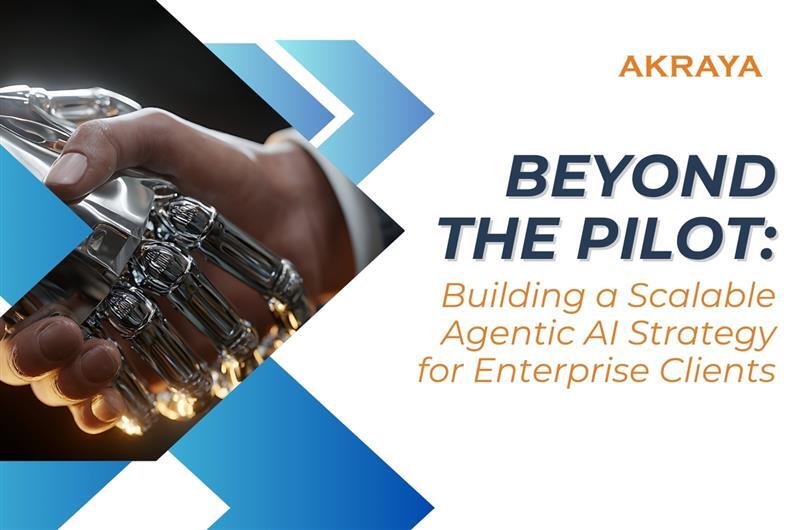
Beyond the Pilot: Building a Scalable Agentic AI Strategy for Enterprise Clients
Rinki Yumnam : March 20, 2026
Beyond the Pilot: Building a Scalable Agentic AI Strategy for Enterprise Clients
Over the past few years, many organizations have experimented with artificial intelligence through small pilot projects. These initiatives have explored chatbots, analytics tools, and automation workflows designed to improve efficiency or enhance customer interactions.
While these pilots have demonstrated the potential of AI, they rarely deliver enterprise-level transformation on their own. The next phase of artificial intelligence adoption requires organizations to move beyond isolated experiments and develop scalable strategies built around agentic AI systems.
Agentic AI refers to systems capable of performing tasks autonomously, coordinating actions across tools and data sources, and adapting to dynamic environments with minimal human intervention.
For enterprises, the challenge is no longer proving that AI works. The challenge is scaling it responsibly and effectively.
Global spending on artificial intelligence is forecast to reach $2.52 trillion in 2026, reflecting how rapidly enterprises are moving from experimentation to large-scale AI adoption.
From Experiments to Operational Systems
Many AI pilots remain disconnected from core enterprise systems. They operate in controlled environments and rely on limited datasets or narrow use cases.
Scaling agentic AI requires deeper integration with enterprise infrastructure. This includes access to data platforms, business workflows, and operational systems.
When AI agents are connected to real operational environments, they can assist with tasks such as analysing complex datasets, coordinating workflows, or supporting decision-making across departments.
Moving from experimentation to operationalization requires robust governance, strong security practices, and clear performance measurement.
Despite rising investment, many AI initiatives struggle to scale, with industry projections indicating that a significant portion of agentic AI projects may be discontinued due to unclear outcomes and governance challenges.
Designing an Agentic AI Architecture
Building scalable agentic AI solutions requires thoughtful architectural design.
Enterprise AI agents must be able to interact with multiple data sources, application programming interfaces, and enterprise platforms. They must also operate within defined boundaries that ensure compliance with organizational policies and regulatory requirements.
Successful implementations often include components such as orchestration layers, monitoring frameworks, and guardrails that govern how agents access information and execute tasks.
This architecture ensures that AI agents operate reliably and transparently within enterprise environments.
This shift is supported by rapid growth in AI infrastructure, with spending on AI-optimized systems and platforms continuing to expand significantly as organizations build the foundations required for scalable deployment.
Governance and Risk Management
As AI agents gain greater autonomy, governance becomes increasingly important.
Enterprises must establish policies that define acceptable use, monitor decision outcomes, and ensure transparency in automated actions. Security, privacy, and ethical considerations must also be integrated into the design and deployment of agentic systems.
Organizations that treat governance as an afterthought risk creating systems that lack accountability or regulatory compliance.
A structured governance framework ensures that AI innovation occurs alongside responsible oversight.
Building the Right Talent and Delivery Model
Scaling agentic AI also requires specialized talent. Organizations need professionals who understand machine learning, data engineering, systems integration, and AI governance.
Equally important is the ability to assemble cross-functional teams that can design, implement, and maintain AI-driven systems.
Enterprises are increasingly partnering with technology service providers that can deliver integrated teams with expertise across AI development, cloud infrastructure, and enterprise integration.
This collaborative approach accelerates AI deployment while reducing implementation risks.
Turning AI Potential into Enterprise Value
The organizations that succeed with agentic AI will be those that move beyond experimentation and treat AI as a core operational capability.
By building scalable architectures, implementing strong governance frameworks, and investing in specialized talent, enterprises can transform AI pilots into systems that deliver sustained value.
Agentic AI represents the next stage of enterprise automation, where intelligent systems collaborate with human teams to solve complex challenges and unlock new opportunities.
At Akraya, Inc., we build and scale AI-enabled delivery models that move beyond pilots to real enterprise impact. Our teams combine AI expertise, data engineering, and governance frameworks to help organizations deploy agentic AI systems that are secure, scalable, and outcome driven.
Connect with us to transform AI experimentation into measurable business value.
How can we help you today?
Case Studies
Accelerating Application Modernization for a Global Commerce Leader
Akraya transformed application infrastructure into a $900M+ revenue accelerator, enabling scalable growth and future-proofing against next-gen demands.
Unlocking Revenue Growth for a Fortune Retailer with Talent On Demand
Akraya’s talent-on-demand strategy transformed merchandising into a predictive revenue engine, driving $8.4B in new sales and enabling the most responsive omnichannel system in the industry.